BLOG
Every byte has neighbours: What The Things Conference 2026 meant to bitteiler
Takeaways from The Things Conference 2026: Maroua Taghouti’s keynote on IoT’s data problem, five ideas on lossless compression and the Women in IoT panel.
Takeaways from The Things Conference 2026: Maroua Taghouti’s keynote on IoT’s data problem, five ideas on lossless compression and the Women in IoT panel.
We went to The Things Conference in Amsterdam with a question: What could IoT do if devices could share more of what they measure, without demanding more from the networks they rely on?
We came home with new conversations, a sense of belonging in this community, and renewed conviction that this question matters well beyond bitteiler.
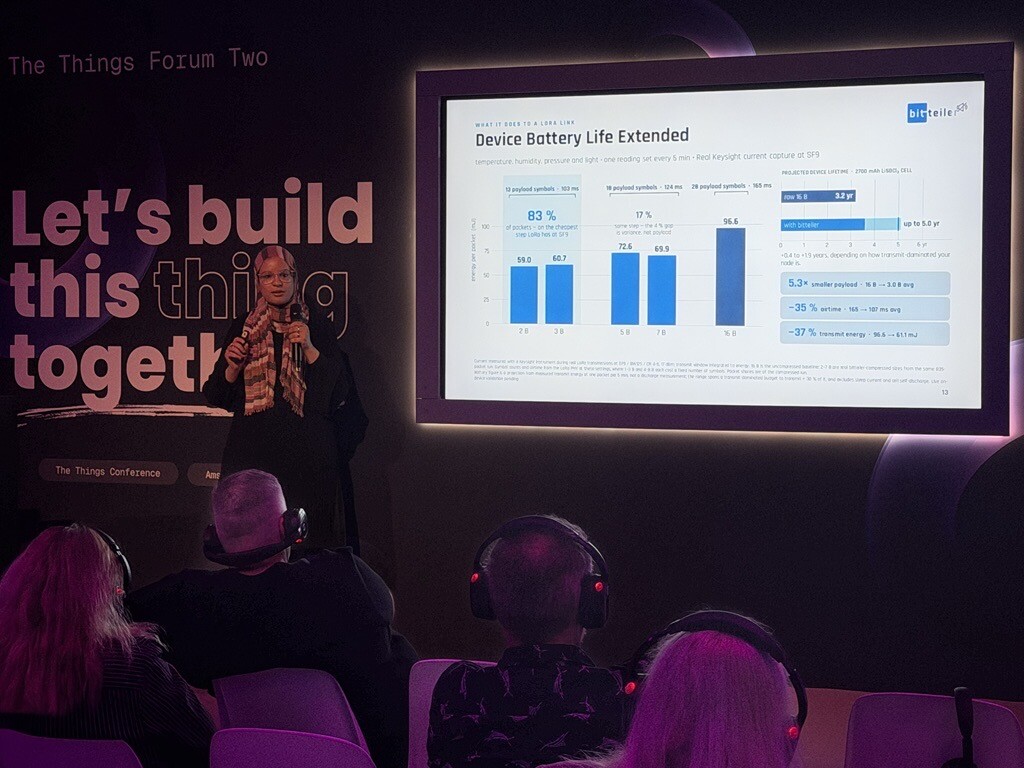
Our co-founder and CTO, Dr. Maroua Taghouti, took the stage with a keynote titled “The IoT industry has a data problem, not a connectivity problem.” She also joined the Women in IoT: Who’s in the Room? panel. Both sessions spoke to the future we want to help build: one where connected devices deliver more useful information, and more people have a voice in deciding what that information is used for.
The strength of the IoT ecosystem was visible everywhere at the conference. Device makers, network providers, researchers, integrators and application teams were sharing working technology and tackling problems together. It was exciting to see how much this community has built and how quickly it continues to move.
Maroua’s keynote focused on a responsibility that comes with that growth. A sensor does not transmit in isolation. Its data crosses a shared network, uses energy and becomes the basis for decisions further down the line. When a device sends more bytes than it needs to, the cost reaches beyond that one device. When it sends too little information, the application may never see the detail it needs.
At bitteiler, we work on lossless compression that runs on constrained devices. It reduces the data they need to transmit while allowing the original measurements to be reconstructed exactly. For us, that is one way to make better use of battery power, connectivity budgets and shared spectrum while keeping richer data available for the applications that need it.
No single company can make IoT more sustainable on its own. But the choices we make at each part of the system add up. The conversations in Amsterdam made us even more eager to work across the ecosystem to make every transmission count.
You can watch Maroua’s keynote. We’ve also made the slides available if you’d like to explore the figures and technical results in more detail: Download the slides.
For a young deep-tech company, one of the most valuable things a conference can offer is an honest conversation.
Our CEO Dr. Máté Tömösközi, Pranay Jain, Maroua (and the assistants) met people who understood the constraints we have spent years working on: a device that could measure more, but has a limited transmission budget; a fleet that needs to last for years; an application that would benefit from detail the system currently leaves behind.
We also heard new questions and new use cases. Those exchanges gave us useful feedback and a welcome feeling that bitteiler had found its community. Thank you to everyone who challenged an assumption, shared a deployment problem or took the time to explore what might be possible together.
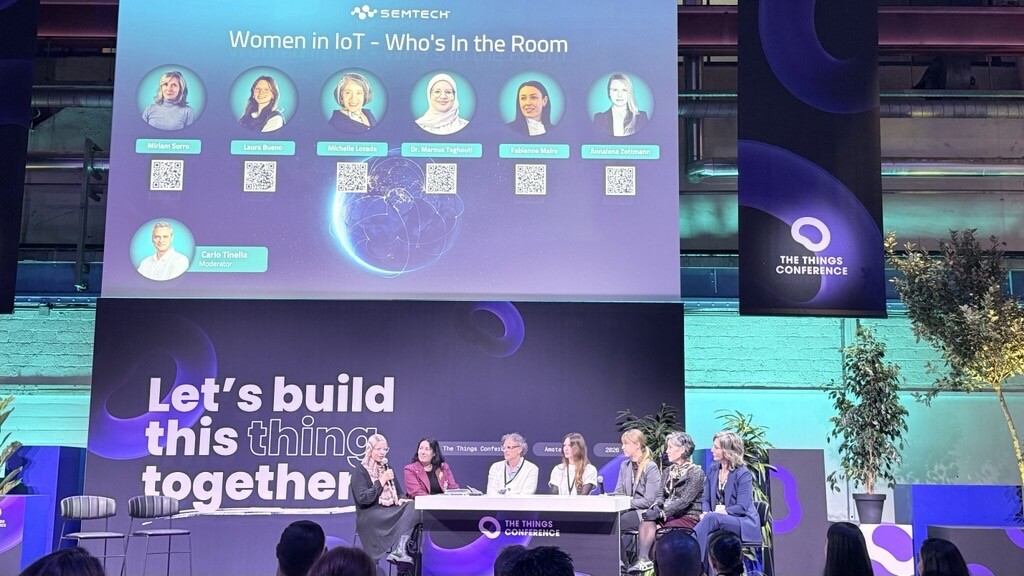
The Women in IoT panel was another highlight for Maroua. The women on stage brought different expertise and different paths into the industry. Their discussion was a reminder of how much the field gains when those perspectives are heard.
A heartfelt thank-you to Semtech for partnering with The Things Conference on this panel. Thank you to Michelle Lozada of Semtech, Laura Bueno, Fabienne Maire of TEKTELIC, Annalena Zottmann of Diehl Metering, and Miriam Surro of Mido for the openness and energy you brought to it. Thank you also to Carlo Tinella of Semtech for guiding the discussion.
What stayed with Maroua was the support among the panelists throughout the event. You showed up for one another as a team, on stage and beyond it. We want to carry that spirit forward: to share opportunities, champion one another’s work and help more women find their place in this industry.
The panel even held the record for the longest session of the event. There was so much to discuss, and everyone brought passion, candour and generosity to the conversation.
It also left us thinking about who is still missing from the room. Women remain underrepresented on technical stages and in many of the roles that shape IoT products. Bringing more brilliant minds into this work takes sustained effort: invitations to speak, visible opportunities to lead, support early in a career, and space for people whose route into technology does not follow a single pattern.
We were glad The Things Conference made room for that conversation. We hope to see even more women sharing their work throughout next year’s programme.
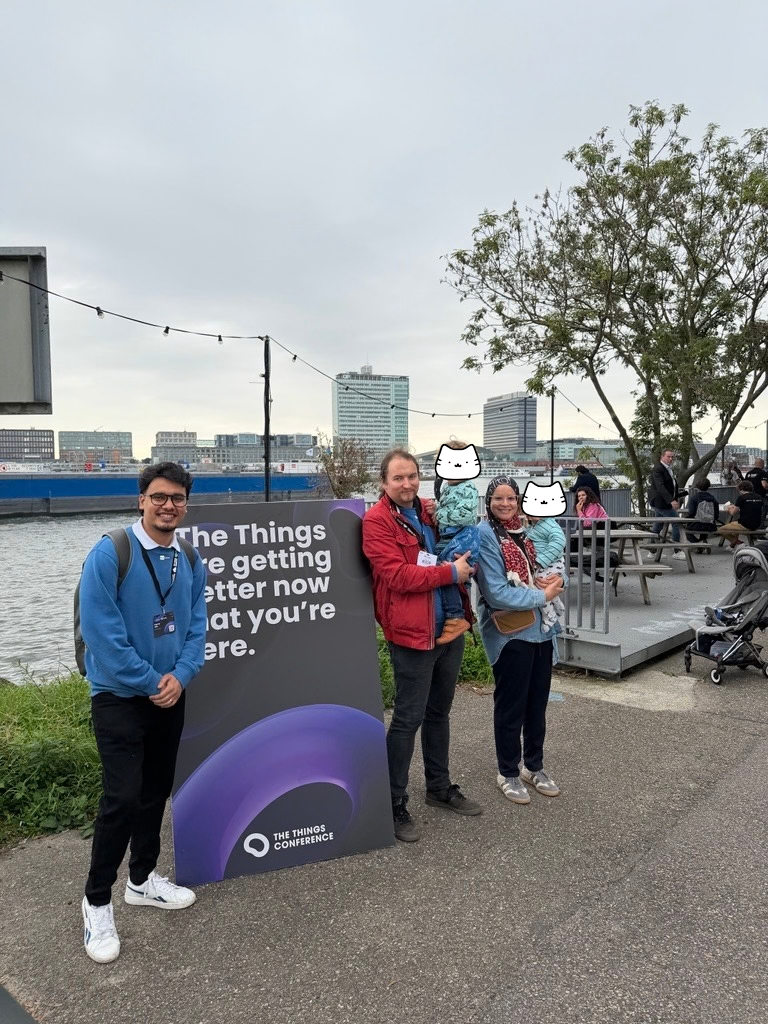
One of our favourite moments happened away from the stage. Our children came with us and explored the devices on the Device Wall. They could see and touch the things the adults around them spend so much time building.
We cannot know what will capture their interest as they grow. But giving children a chance to encounter technology with curiosity, in a place full of people who care about its purpose, feels meaningful. That is part of a conference’s legacy too: inspiring the people who may one day build what comes next.
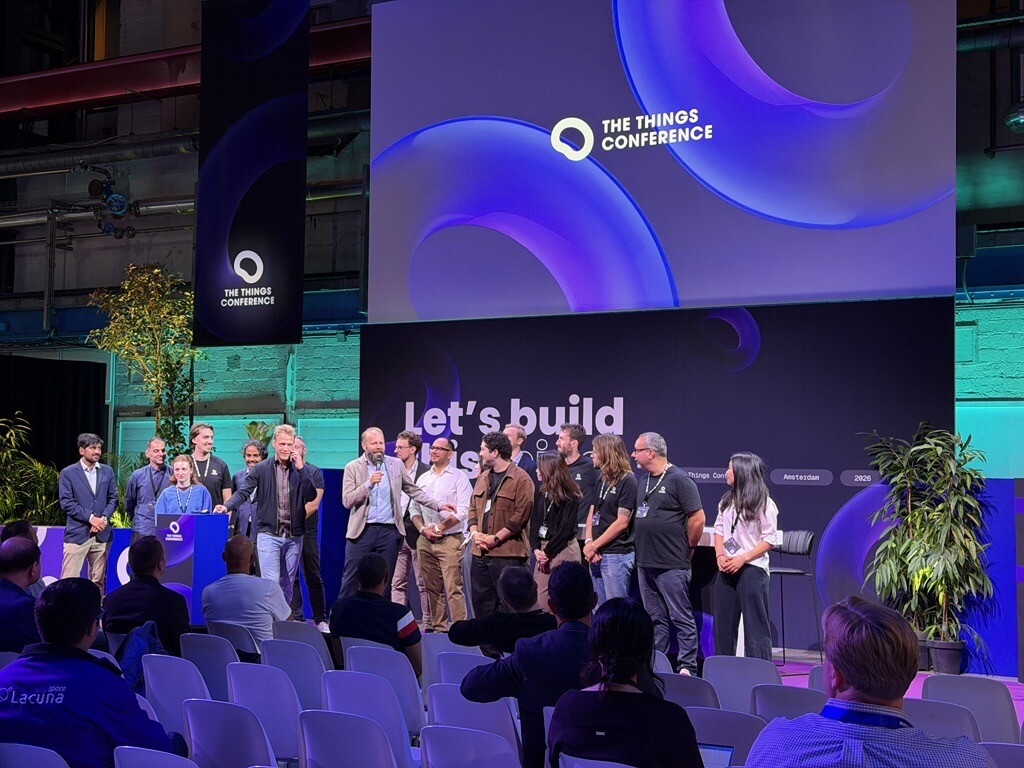
To the team at The Things Industries: thank you for creating such a welcoming place for this ecosystem to meet. We know an event of this scale takes immense work. Your warmth and calm throughout made that work look effortless, and gave us something to aspire to as we grow bitteiler.
Thank you also to 5V Tech for sharing bitteiler’s open positions on the conference Jobs Board. Giving companies and people who care about IoT a place to find one another was a thoughtful initiative.
We are grateful to the German Federal Ministry of Transport for the financial support that has helped us develop bitteiler’s technology and bring this work to the IoT community.
We are already looking forward to returning next year. For anyone building in IoT, The Things Conference has become a gathering we would not want to miss.
Let’s make every bit count.
Dr. Maroua Taghouti, co-founder and CTO of bitteiler, gave the keynote “The IoT industry has a data problem, not a connectivity problem.” It argued that every byte a sensor sends costs airtime, energy and shared network capacity, and that lossless compression lets devices send less without discarding detail.
Lossless compression reduces the number of bytes a device has to transmit while allowing every original measurement to be reconstructed exactly. bitteiler’s compression runs on constrained devices, so the saving happens before data leaves the sensor.
In one SF9 LoRa test presented at the conference, a 16-byte sensor report shrank to 3 bytes on average, cutting airtime by 35% and transmit energy by 37%.
No. In a multi-sensor STWIN benchmark covering 40,000 packets, bitteiler achieved an 84.6% compression gain at a batch size of one, meaning savings start from the first packet.
Estimate the bandwidth, airtime and energy your sensor fleet could save, or book a live demo with our team.
Join our newsletters. We’ll send you only the essentials
(compressed, of course). No spam, we swear.
By subscribing to our newsletters you agree to our Privacy policy.
Join our newsletters. We’ll send you only the essentials (compressed, of course). No spam, we swear.
By subscribing to our newsletters you agree to our
Privacy policy


AI-powered compression for reliable, scalable, and energy-efficient IoT networks.


